
Our research group specializes in advanced numerical modeling and observational studies of pelagic Sargassum dynamics in the Tropical Atlantic. A central focus of our work is the development of the NEMO-Sarg1.0 model, a coupled biogeochemical-physical framework designed to simulate the distribution and biomass evolution of these macroalgae. We employ both Eulerian and Lagrangian approaches to investigate the mechanisms governing Sargassum growth and decay, and to conduct retrospective analyses of major events.
A significant portion of our research is devoted to identifying the complex environmental drivers that trigger and sustain massive Sargassum proliferations. We have investigated the role of riverine nutrient exports and examined the disruptive effects of tropical cyclones on seaweed transport and accumulation. More recently, our investigations have expanded to include the influence of mesoscale eddies on transport processes and the role of large-scale climate modes, revealing that extreme climatic events can act as tipping points for the current regime of Atlantic Sargassum blooms.
Moreover, our team is at the forefront of enhancing operational monitoring and predictive capabilities to mitigate the socio-ecological impacts of Sargassum beaching. We have developed high-resolution remote sensing datasets for coastal regions and used satellite observations to characterize the thermal signatures of seaweed aggregations. These observational efforts support the development of skillful seasonal and stranding forecasts, which are essential for operational management. Through comprehensive socio-ecological assessments, we aim to bridge the gap between physical oceanography and sustainable management, particularly for vulnerable coastal communities.
Our research group specializes in the advanced numerical modeling and observation of pelagic Sargassum dynamics within the Tropical Atlantic. A core pillar of our work is the development of the NEMO-Sarg1.0 model, a biogeochemical-physical coupled framework designed to simulate the distribution and biomass evolution of these macroalgae. We employ both Eulerian and Lagrangian approaches to investigate the mechanisms behind the growth and decay of Sargassum, as well as to perform retrospective analyses of significant events.
A significant portion of our research focuses on identifying the complex environmental drivers that trigger and sustain massive Sargassum proliferations. We have explored the critical role of riverine nutrient exports from the Amazon and Mississippi basins and the disruptive influence of tropical cyclones on seaweed transport and accumulation. More recently, our investigations have expanded to include the role of mesoscale eddies in transport and the impact of large-scale climate modes, revealing that extreme North Atlantic Oscillation (NAO) events served as a tipping point for the current regime of Atlantic Sargassum blooms.
Furthermore, our team is at the forefront of improving operational monitoring and predictive capabilities to mitigate the socio-ecological impacts of Sargassum beaching. We have developed high-resolution remote sensing datasets for coastal regions and utilized Landsat 9 observations to characterize the thermal signatures of seaweed aggregations. These observational efforts support our development of skillful seasonal and stranding forecasts, which are essential for operational management. By conducting comprehensive socio-ecological assessments, we aim to bridge the gap between oceanography and sustainable management, particularly for vulnerable communities in the Global South.
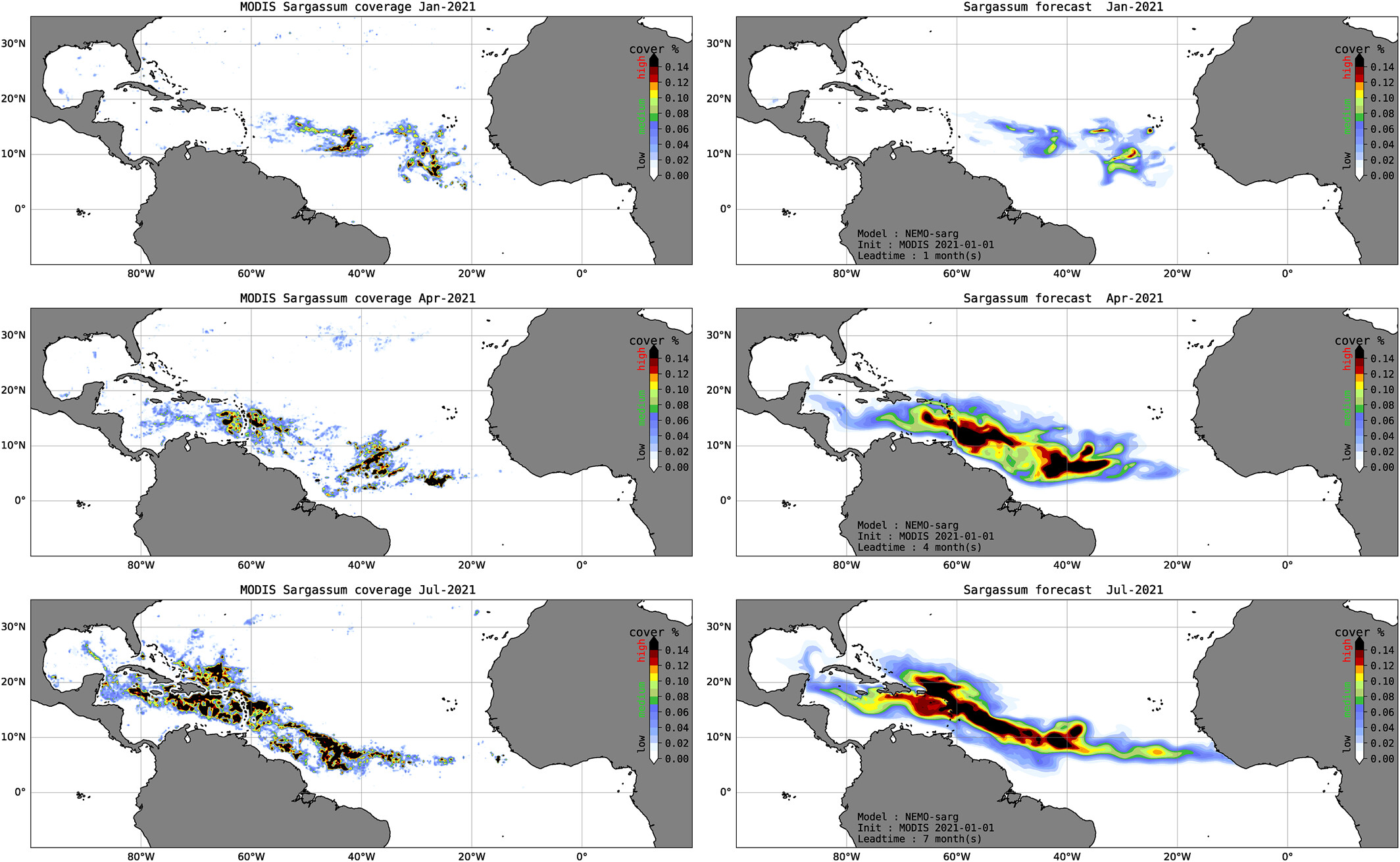
Figure : Illustration of seasonal forecast capacity (Jouanno et al. 2023)