
Eddy-Induced Spatial Variability of Chlorophyll Concentration from SWOT and In-Situ Observations
Encadrants:
Gwendal Marechal: gwendal.marechal@utoulouse.fr
Lionel Renault: lionel.renault@ird.fr
Faycal Kessouri: faycal.kessouri@ird.fr
Sujet
This project aims to leverage the recently launched NASA & CNES satellite; Surface Water and Ocean Topography (SWOT), in mapping mesoscale eddies and their role in the chlorohyll concentration heterogeneity at the surface of the ocean. Mesoscale eddies are closed circular current contours with 10-100 km radius. They are keys in the ocean energetics, exchanges between the upper ocean and the lower atmosphere, and biogeochemical cycles. In particular, interactions between eddies-induced current and surface wind drive local upwelling through what we call the eddy-induced Ekman pumping. This pumping generates upwelling (downwelling) in the interiors of cyclones (anticyclones). These vertical motions can influence nutrient availability in the upper ocean and may therefore contribute to regional hotspots and deserts of chlorophyll concentration.
Eddy atlases have been created in our team which provide eddy locations and shapes in Gulf-Stream region for several satellite current products. We chose to focus in the Gulf Stream as it represents one of the most energetic and eddy-rich regions of the global ocean.
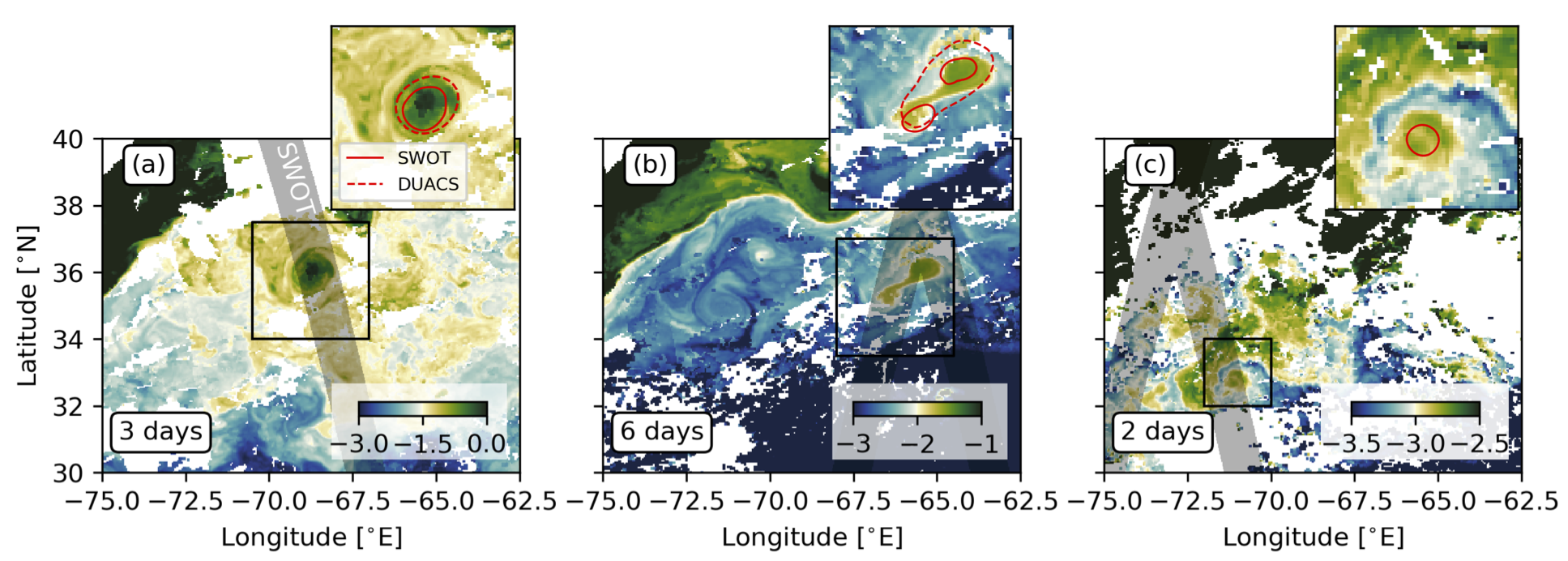
region (averages of satellite data over 3, 6, and 2 days). The insets above each figures provide a
zoom around detected eddies within SWOT observations (solid lines) and DUACS maps
(combination of altimeters in dashed lines).
After a litterature review of eddy-induced spatial variability of chlorophyll, the first goal of the project is to combine ocean current dataset with satellite observation of ocean color and provide a statistical comparison of mean spatial structure of chlorophyll concentration within ocean eddies observed by SWOT and from constellation of traditional altimeters, these latter represented the state of the art of the ocean surface dynamic before the launch of SWOT. This comparison will allow us to assess whether the smaller-scale eddies newly resolved by SWOT exhibit distinct chlorophyll signatures and to quantify the contribution of these structures to chlorophyll variability. The observational results will also be compared with outputs from coupled physical–biogeochemical numerical simulations available within our team.
The second objective will be to combine the satellite-derived eddy atlases with three-dimensional observations from the Argo profiling-float array. This analysis will investigate the vertical structure of chlorophyll anomalies throughout the upper ocean and determine whether their signatures differ according to eddy size and observability. In particular, we will compare large eddies detected by both conventional altimetry and SWOT with smaller eddies that are resolved exclusively by SWOT. This will provide new insights into whether the enhanced spatial resolution offered by SWOT reveals a contribution of small mesoscale eddies to the three-dimensional distribution of chlorophyll and, more broadly, to upper-ocean biogeochemical variability.
Idealy, the internship will begin in April 2027. Candidates can reach out the main supervisor (Gwendal Marechal) at the provided e-mail adress.

